FindRE
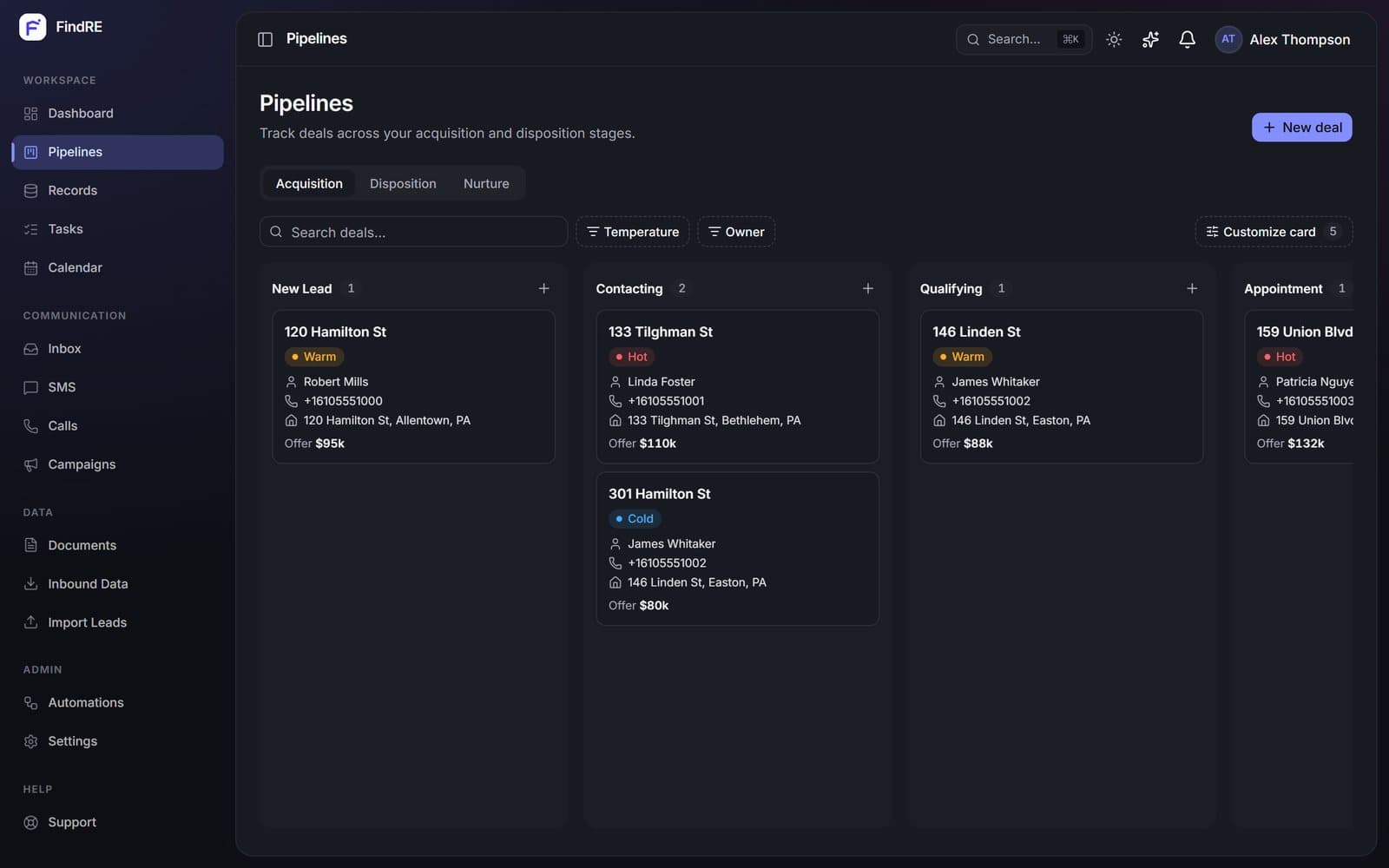
As fractional CTO for a real-estate investment company, I moved the team off a patchwork of tools and built FindRE, the CRM they now run acquisitions in.
Abdur Rehman is a fractional CTO and AI engineer for startups and small companies that need senior technical leadership without a full-time hire. He sets the technical direction, makes the build-or-buy calls and builds the critical parts himself. As fractional CTO for a real-estate investment company, he replaced their tool stack with FindRE, a custom AI-powered CRM.
Last reviewed
Architecture, stack and build-or-buy decisions written down in plain language, so you can explain them to investors, partners and your team.
I build the pieces that carry the most risk myself: the data model, payments, permissions and the AI features.
I review vendor proposals, contractor work and estimates, and tell you plainly what is sound and what is not.
Code in your repository, infrastructure on your accounts, and documentation good enough that you never depend on one person.
A fractional CTO provides senior technical leadership part-time. They set the technical direction, make the architecture and vendor decisions, keep delivery on track and make sure the company owns what it builds, without the cost of a full-time executive.
For an early-stage company, the useful version also builds. Strategy documents do not ship products.
When technical decisions have become business decisions and nobody on your team can own them: before a major build, when you are choosing between vendors, when a product built by contractors needs to grow up, or when investors start asking technical questions.
If you need someone leading a team of engineers every day, you need a full-time CTO or an engineering manager instead.
It depends on the hours and the seniority. Google’s AI summary for this question currently quotes US fractional CTOs at roughly $9,000 to $22,000 a month. I agree the scope and the fee up front, sized to what the company needs.
It takes one of three shapes, and companies often move between them as they grow.
There are three, and each has a plain answer. Divided attention: agree fixed days and a response time for urgent questions. Advice with no delivery: choose someone who still writes code. Knowledge that leaves with the person: keep the code in your repository, the infrastructure on your accounts and the decisions written down.
I work that way by default, so the company owns everything whether I am there or not.
They solve different problems.
The same responsibility, arranged three ways. An interim CTO is full-time for a fixed period, usually to cover a gap or lead a transition. A part-time CTO gives one company a fixed number of days each week. A fractional CTO holds the role for a few companies at once, with each engagement sized to what that company needs.
I work fractionally, in one of the three shapes above, and the shape can change as the company grows.
As fractional CTO for a real-estate investment company, I moved the team off a patchwork of tools and built FindRE, the CRM they now run acquisitions in.
I went in looking for a developer and came out feeling like I’d found someone I could genuinely rely on and even see as a future co-founder, not just someone to build with, but someone you could build a company with.
Your systems, vendors, costs and risks, and what the business needs from technology next.
A short written plan: what to build, what to buy, what to fix, and in what order.
I write the code that carries the most risk, and review the rest.
Documentation and handover, so the system and the knowledge stay with your company.
Straight answers. If yours is not here, ask me.
 Ask me directlyI read and answer every message.
The responsibility is the same: someone owns the technology decisions and answers for them. The difference is time. A full-time CTO leads an engineering team every day. A fractional CTO gives a company that ownership for part of the week.
Yes, often. I explain decisions in plain language, so you always know what is being built and why.
Both. I set the direction and I write code. For an early-stage company, the two should not be separated.
Yes. If AI is central to your product or operations, I can own that area: choosing models and vendors, designing the agents and automations, and keeping cost and risk under control.
It varies by company and stage. We agree a scope up front and adjust it as the company’s needs change.
Start with founders you trust. Then look for people whose work you can open: live products, detailed case studies and plain writing about how they make decisions. Agree a short paid engagement before a long one.
Yes. The code lives in your repository and runs on your accounts. You own the code, the accounts and the data, so you are never locked in to me.
Guide5 min read
A practical, first-hand guide to building an AI agent: define one job, design the tools, limit its power, test on real examples and control cost.
Guide4 min read
What to fix before real users and payments hit a Lovable, Bolt or Replit app: database rules, secrets, Stripe webhooks, background jobs and deployment.
Guide6 min read
A fractional CTO gives a company senior technical leadership part-time. What they do, what they cost, the real risks, and how to tell whether you need one.
Agents that use your tools and data, take approved actions and hand off to people when it matters.
AI-native products built to take paying customers from the first release.
A straight answer on where AI is worth using, what to build first and what it will take.
Tell me where the company is and what is stuck. I’ll tell you whether a fractional CTO is what you need.
You’ll talk to me directly.On the call and in every message.
Or email hello@abdurrehman.dev