The problem
A real-estate investment team was running acquisitions across a patchwork of tools: a marketing CRM, a separate dialer, a texting app, an e-signature service and spreadsheets to hold it together. I worked with the team as their fractional CTO, responsible for the technical direction as well as the build.
Every handoff between tools was a place for a lead to go cold. Follow-ups depended on someone remembering, call notes lived in people’s heads, and nobody could see the whole pipeline in one place.
What I built
One pipeline for every lead
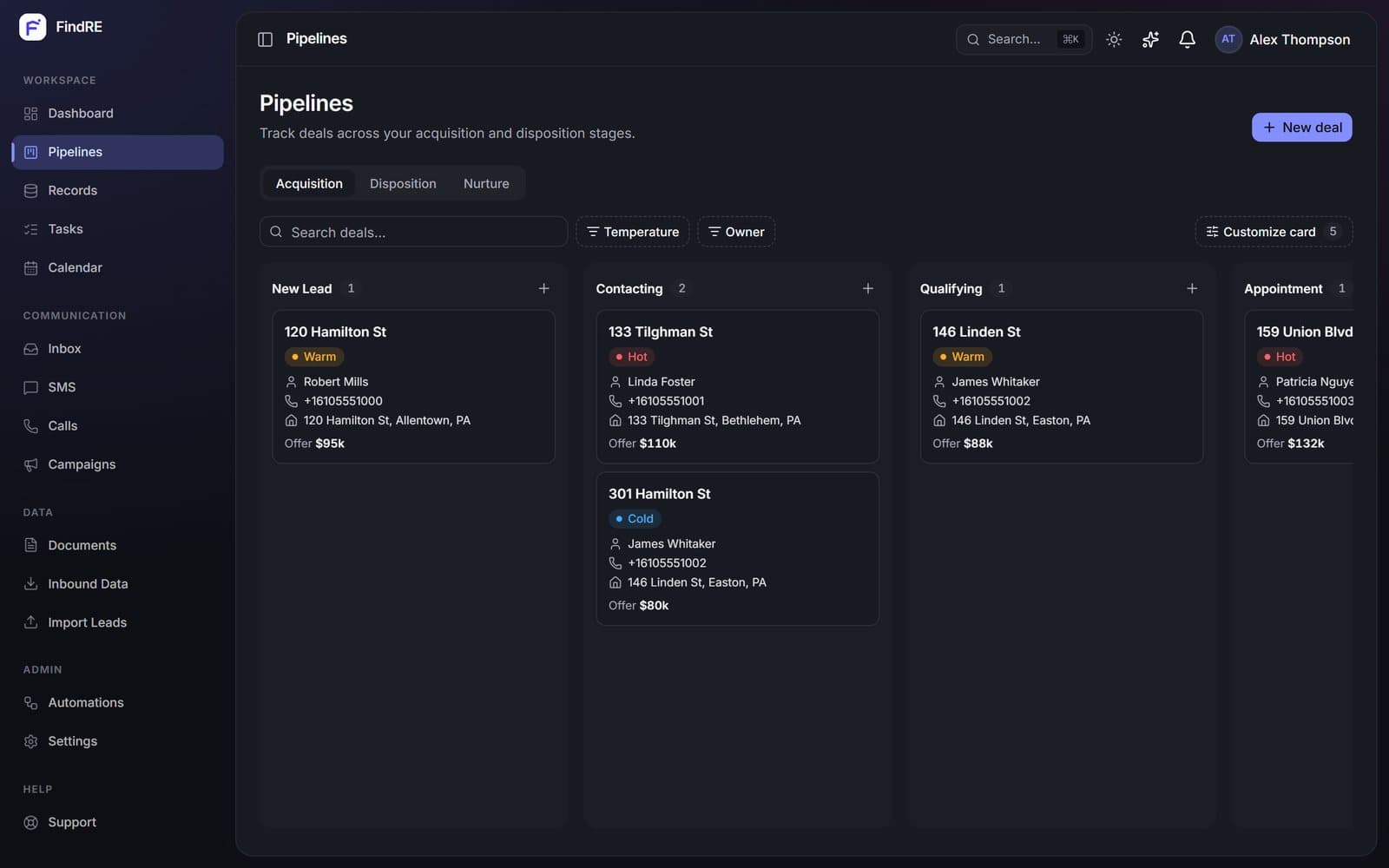
Leads, properties, tasks and deals live in one place with skip tracing built in, separated per company so each team only ever sees its own data.
Calling and texting in the browser
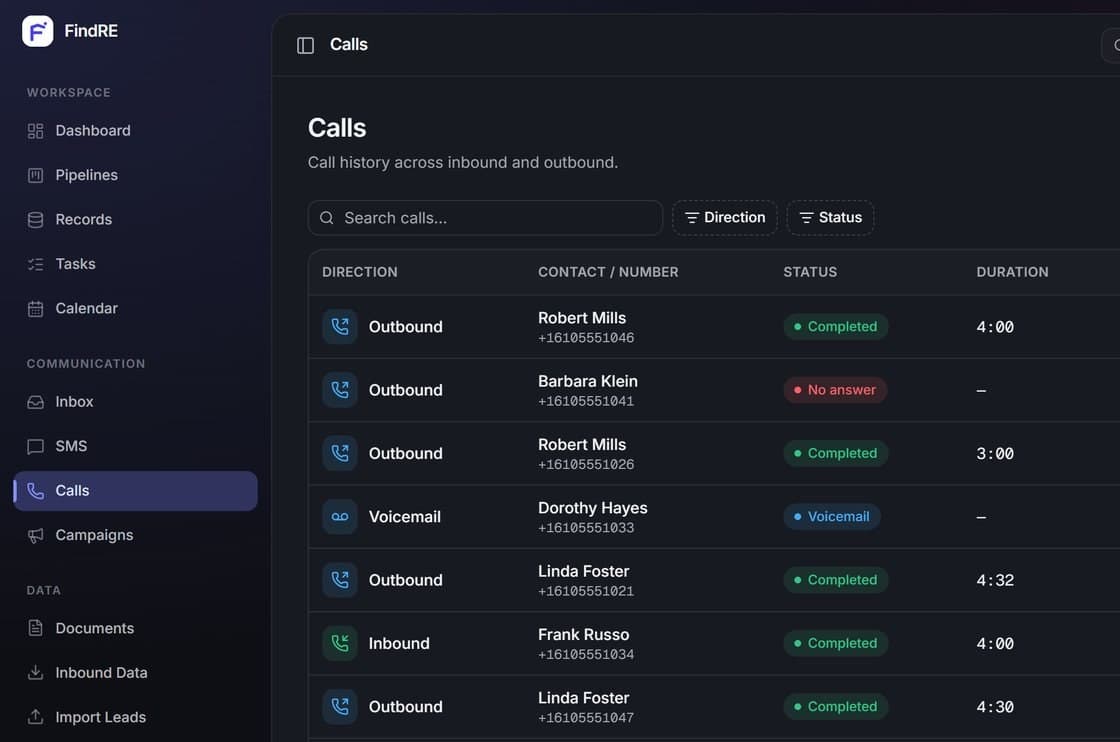
The team calls and texts sellers from the CRM itself. Every call and message is logged against the lead automatically.
AI that does the follow-up work
After a call, AI writes the summary and suggests the next step. It drafts replies to incoming messages, so a person only has to review and send.
Contracts without leaving the deal
Agreements go out for e-signature from the deal page and come back signed and filed.
Rules that run the routine
A rule engine lets the team automate the predictable steps, so routine follow-up does not depend on someone remembering.
An MCP server for AI assistants
A Model Context Protocol server exposes the CRM as a small set of permissioned tools, so an AI assistant can work with leads and deals on request without direct database access.
How it runs
The core loop, from the moment something happens to the moment it is handled.
How it runs: Call, then AI summary, then Follow-up.
What changed
- The team moved off their old marketing CRM and now runs acquisitions in FindRE.
- What started as an internal system is now offered to other investors as a product.
Under the hood
- TypeScript end to end
- React and Next.js front end
- Node.js (Fastify) API with PostgreSQL and Prisma
- Background jobs on Redis queues
- Twilio voice and SMS
- E-signature integration
- LLM features through OpenRouter
- Model Context Protocol server
Want something like this?
Fractional CTO
Senior technical leadership for startups and small teams, from someone who still builds.
AI agents
Agents that use your tools and data, take approved actions and hand off to people when it matters.
Custom CRMs
One system for leads, calls, texts, contracts and follow-ups, shaped around your process.
MCP servers
Safe, permissioned tools that let Claude and other AI assistants work with your product’s data.
Related guides
Guide5 min read
AI for real estate investors: what actually works, from someone who built it
How real estate investors actually use AI: leads from public records, call summaries, reply drafts and follow-up rules, from the engineer who built FindRE.
Guide5 min read
How to build an AI agent that survives production
A practical, first-hand guide to building an AI agent: define one job, design the tools, limit its power, test on real examples and control cost.
Guide5 min read
How to build an MCP server for your product
A first-hand guide to building a custom MCP server: choosing tools, writing descriptions for the model, enforcing permissions, transports and testing.
Guide6 min read
What is a fractional CTO? Cost, scope, risks and when to hire one
A fractional CTO gives a company senior technical leadership part-time. What they do, what they cost, the real risks, and how to tell whether you need one.
Questions about FindRE
Straight answers. If yours is not here, ask me.
 Ask me directlyI read and answer every message.
Why build a custom CRM instead of configuring an off-the-shelf one?
The team had already tried that. Their process needed calling, texting, contracts and follow-up rules to work as one flow, and general-purpose CRMs could only do it with add-ons and manual steps in between. A custom system fits the process instead of bending the process to fit the tool.
What does the AI actually do in FindRE?
It writes a summary and a suggested next step after each call, drafts replies to incoming messages, and summarises a lead’s history. A person reviews before anything is sent.
What is the MCP server for?
It lets AI assistants such as Claude work with the CRM through a small set of permissioned tools, without giving them direct database access.